 +86 18531742341
Leave Your Message
Choosing the best Scaffolding Accessories from China requires more than comparing prices on a supplier website. Quality appears in small details, such as clean welds, accurate dimensions, smooth threads, and consistent galvanizing. During supplier evaluations, experienced buyers often inspect couplers, base jacks, swivel clamps, castors, platforms, and guardrail components together. A single weak fitting can affect the stability of an entire scaffold system.
China offers a broad manufacturing base for these products. Reliable factories usually provide material certificates, dimensional reports, load-testing records, and traceable production batches. They should also explain their quality-control process clearly. Product samples deserve careful attention. Check the pin fit, locking action, coating thickness, edge finishing, and packaging strength. Ask how the accessories perform after repeated assembly, transport, rain, and dust exposure. These practical questions reveal more than attractive catalog photos.
The “best” choice depends on the project, not only the supplier’s reputation. Industrial construction may require heavy-duty steel components, while interior work may favor lighter, faster-installing accessories. Recognized standards and local safety requirements must guide every purchase. Independent inspection can reduce uncertainty before shipment.
No checklist is flawless. Even experienced buyers can overlook small deviations. That is why clear specifications, sample approval, factory audits, and final inspections should work together. This article examines the most useful Scaffolding Accessories from China and explains how to assess their safety, durability, compatibility, and overall value with greater confidence.
What Are the Best Scaffolding Accessories from China?
Scaffolding Accessories: Functions, Types, and Essential Uses
Scaffolding accessories control stability, access, load transfer, and worker protection. Their value appears on site, not in a catalogue.
Base jacks level uneven ground and transfer loads into firm support. U-head jacks hold beams or frames beneath slabs. Swivel couplers connect tubes at changing angles, while right-angle couplers create rigid connections. Sleeve couplers extend standards without awkward overlaps. Steel access ladders, toe boards, guardrails, and mesh panels reduce fall and falling-object risks.
According to OSHA 29 CFR 1926.451, scaffold components must support at least four times the maximum intended load. That requirement makes material testing and load records essential. The UK Health and Safety Executive reported 50 worker deaths from falls from height in 2023/24. Small accessories deserve serious attention.
For China sourcing, buyers should request mill certificates, coating measurements, dimensional reports, and batch traceability. Hot-dip galvanized surfaces usually suit damp projects, but coating quality can vary. A cheap clamp can look perfect. It may still fail inspection.
Inspect threads for smooth movement and check pins for complete engagement. Confirm tube diameter, wall thickness, and compatibility before ordering. EN 74 and EN 12811 references can help define coupler performance and scaffold design expectations. These standards do not replace local engineering approval.
I would not judge accessories by weight alone. Excessive weight may indicate poor efficiency, not strength. Better decisions combine tested performance, site experience, and consistent inspection records.
| Accessory Type | Primary Function | Common Material and Finish | Typical Scaffolding Compatibility | Essential Use | Key Selection Criteria | Relevant Safety Considerations |
|---|---|---|---|---|---|---|
| Adjustable Base Jack | Levels and stabilizes the scaffold at uneven ground conditions. | Carbon steel, commonly hot-dip galvanized or electro-galvanized. | System scaffolding, frame scaffolding, and tube-and-coupler systems. | Creates a stable, adjustable connection between the scaffold standard or frame and the supporting surface. | Thread diameter, adjustment range, base-plate size, weld quality, and corrosion protection. | Use on a suitable sole board or firm foundation; do not exceed the approved adjustment range. |
| U-Head Jack | Supports and levels beams, bearers, or formwork members at the top of a scaffold tower. | Steel screw stem with a pressed or fabricated U-shaped head; galvanized finishes are common. | Shoring towers, ringlock systems, cuplock systems, and formwork support frames. | Provides adjustable top support for horizontal timber or steel members. | U-head dimensions, stem diameter, adjustment range, load rating, and compatibility with the supporting beam. | Load must be centered and transferred through the intended bearing surfaces. |
| Right-Angle Coupler | Connects two scaffold tubes at a fixed 90-degree angle. | Pressed or forged steel, usually galvanized for outdoor corrosion resistance. | Tube-and-coupler scaffolding using matching tube outside diameters. | Builds ledgers, transoms, guardrails, façade ties, and rigid rectangular scaffold arrangements. | Tube diameter fit, slip resistance, bolt quality, jaw alignment, and conformity with EN 74-1 where specified. | Tighten to the manufacturer’s instructions and inspect for distortion, cracks, or damaged threads. |
| Swivel Coupler | Joins two scaffold tubes at variable angles. | Forged or pressed steel with galvanized or painted protection. | Tube-and-coupler systems with compatible tube dimensions. | Provides diagonal bracing and helps create irregular or non-rectangular scaffold layouts. | Rotation range, slip resistance, clamp strength, tube fit, and compliance with the required coupler standard. | Bracing layout must follow the design; a swivel coupler should not be substituted for a fixed coupler where a rigid 90-degree joint is required. |
| Sleeve Coupler | Connects two scaffold tubes end-to-end to extend their length. | Steel sleeve body with bolts or locking components; galvanized finishes are widely used. | Tube-and-coupler scaffolding with matching tube sizes. | Extends ledgers, standards, braces, or other continuous tube members. | Internal fit, axial load performance, locking method, tube tolerance, and corrosion resistance. | The joint should be positioned and restrained according to the scaffold design; damaged sleeves must be removed from service. |
| Putlog or Single Coupler | Connects a scaffold tube to a support or structural member while allowing the tube to terminate at the connection. | Pressed or forged steel, generally galvanized or painted. | Traditional tube-and-coupler scaffolding. | Useful for connecting transoms or putlogs to ledgers and supporting platform components. | Tube diameter, clamp geometry, slip resistance, bolt condition, and required load capacity. | Confirm that the connection is suitable for the intended structural duty and does not replace a required load-bearing coupler. |
| Ledger and Transom | Forms the horizontal framework that supports platforms and ties scaffold standards together. | High-strength steel tubes or formed steel sections, commonly galvanized or painted. | Ringlock, cuplock, frame, and tube-and-coupler systems, depending on connection design. | Provides horizontal stability, platform support, and the basic scaffold grid. | Length, tube diameter, connection type, section thickness, straightness, and system compatibility. | Do not mix incompatible connection systems without engineering verification. |
| Diagonal Brace | Controls sway and improves the overall stability of the scaffold structure. | Steel tube or pressed steel brace with painted, galvanized, or powder-coated finish. | Frame, ringlock, cuplock, mobile tower, and tube-and-coupler scaffolding. | Resists lateral movement caused by wind, work activity, and uneven loading. | Correct length, connection head design, locking pins, system compatibility, and corrosion condition. | Install the bracing pattern specified by the design or manufacturer; never omit required braces. |
| Scaffold Platform or Steel Plank | Creates a working surface for personnel, tools, and approved materials. | Galvanized perforated steel, aluminum, or engineered timber depending on the system. | Frame, ringlock, cuplock, mobile tower, and other compatible scaffold systems. | Provides a level, slip-resistant access and work deck. | Length, width, rated duty, end hooks, anti-slip surface, deflection, and platform locking method. | Fully deck the required bay, secure planks against movement, and observe the specified working load. |
| Guardrail and Midrail | Reduces the risk of falls from open platform edges. | Steel tubes, aluminum sections, or system-specific guardrail components. | Most scaffold systems when the guardrail connection matches the standard or system design. | Provides top-edge and intermediate fall protection around working platforms. | Height, connection security, tube diameter, continuity, and compliance with local working-at-height rules. | Install with toe boards where required and maintain protection at every exposed platform edge. |
| Toe Board | Helps prevent tools, materials, and feet from sliding off the platform edge. | Galvanized steel, aluminum, or treated timber, depending on the scaffold design. | Frame, system, mobile tower, and tube-and-coupler scaffolding. | Provides edge containment on working decks and access platforms. | Height, length, retention clips, corrosion resistance, and fit with the platform edge. | Fit continuously where required and avoid gaps that could allow objects to fall. |
| Access Ladder or Stair Unit | Provides controlled movement between scaffold levels. | Aluminum or galvanized steel, with anti-slip rungs or treads. | Frame scaffolding, mobile towers, system scaffolding, and access towers. | Supports safer personnel access than climbing on braces or external scaffold members. | Length, width, inclination, rung spacing, anti-slip features, landing arrangement, and locking method. | Secure the unit properly and provide gates, guardrails, or access openings as required by the design. |
| Scaffold Tie and Anchor | Connects the scaffold to a suitable building structure to improve stability. | Steel tie tubes, couplers, eye bolts, anchor components, and galvanized hardware. | Tube-and-coupler, frame, ringlock, and cuplock scaffolding. | Limits outward movement and helps transfer horizontal forces to the supporting structure. | Anchor capacity, substrate type, tie spacing, corrosion protection, and compatibility with the scaffold design. | Anchors must be installed in sound structural material and checked by a competent person. |
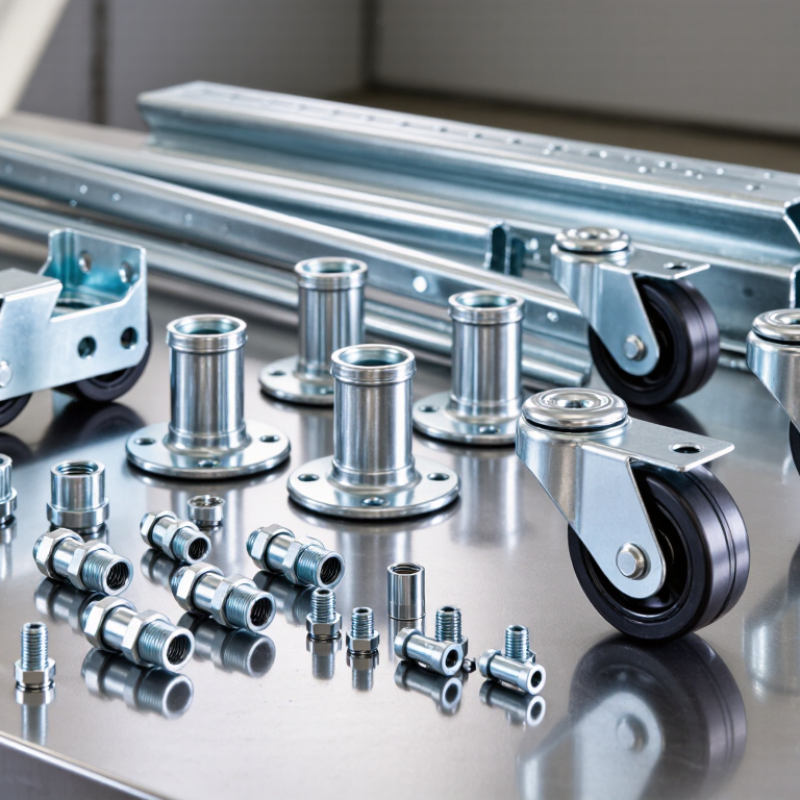
| Caster Wheel | Allows a properly designed mobile scaffold tower to be repositioned. | Steel or aluminum mounting stem with polyurethane, rubber, or nylon wheel and a locking brake. | Mobile towers and purpose-designed rolling scaffold systems. | Improves mobility on smooth, firm, and level surfaces. | Wheel diameter, rated capacity, stem size, brake performance, floor suitability, and tower compatibility. | Lock all wheels before use; never move an occupied tower unless the equipment and procedure specifically permit it. |
| Base Collar or Rosette Component | Provides a standardized starting connection for ledgers, transoms, and braces. | Pressed or forged steel welded to a steel standard; galvanized finishes are common. | Ringlock or rosette-based modular scaffolding systems. | Creates the first level connection and helps maintain consistent bay geometry. | Rosette spacing, wedge design, welding quality, standard diameter, and system interchangeability. | Use only components designed for the same modular system and inspect wedges and rosettes for deformation. |